Fluvsies Pocket World
- 3.6
- Rating
- 10.00M
- Installs
- Free
- Price

 Analysis by App-foxy
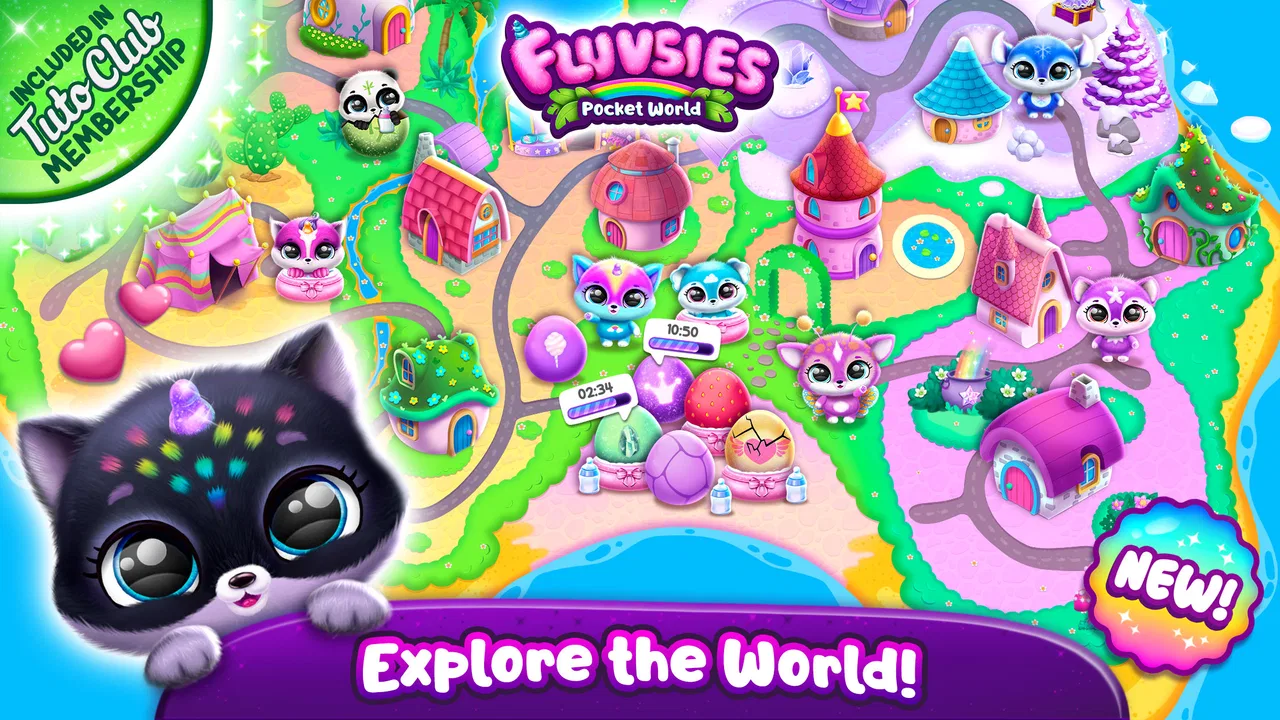
I spent time with Fluvsies Pocket World as a child-focused educational game, and its main appeal became clear quickly: it turns collecting virtual pet eggs into the central reason to explore, care for fluffy creatures, and keep returning to the world. That single idea gives the game an easy rhythm for younger players. There is always something visually inviting to discover, but the experience stays gentler and less demanding than a traditional action game.
The game is made by TutoTOONS and is free to start, with an Everyone content rating. It has reached over 10 million installs and holds an average rating of 3.8 from around 40 thousand ratings, so it is clearly familiar to a large family audience. Those figures do not tell me whether every child will enjoy it, but they do suggest that the basic pet-and-collection formula has broad appeal.
Why collecting eggs is the game’s real strength
The egg-collecting idea works because it gives children a simple goal without requiring them to understand complicated rules first. Instead of presenting a long tutorial or asking a young player to master difficult controls, the game encourages curiosity. A child can look around, interact with the pet world, and treat each new egg as a small mystery. That is a much more approachable starting point than many educational games that feel like disguised worksheets.
You May Also Like

 Blood Strike: 2.5 Anniversary
Blood Strike’s Loadouts Turn Every Drop Into a Tactical Gamble
A close look at Blood Strike’s custom loadouts: how fast access to signature weapons reshapes its battle royale rhythm, rewards preparation, and narrows the gap between fights.

 Pandora - Music & Podcasts
Pandora’s Music Is Easy to Start, but Harder to Recover
Pandora’s strength is its low-effort path from a seed to a station. Its weak spot is how much confidence it asks you to place in connection, setup, and quiet recovery.

 8 Ball Pool
 Is Built on Rivalries, Rematches, and Routine
A close look at the rivalries, rematches, shared routines, and unanswered safety questions that turn a quick pool match into a persistent mobile community.

 Samsung Music
’s Quiet Strength Is Playing What You Already Own
Its reach comes less from spectacle than from dependable access to a personal library. That simplicity is both the app’s strongest retention engine and its ceiling.

 AccuWeather: Weather Radar
AccuWeather Review: A Quick, Clear Forecast for Everyday Decisions
For everyday plans, the best forecast is the one you can understand quickly. AccuWeather makes rain timing, radar, and local conditions easy to act on, with a few trade-offs.

 Hill Climb Racing
Why Hill Climb Racing Still Turns Crashes Into One More Run
A tiny car, a bumpy hill and one more upgrade: Hill Climb Racing keeps resurfacing because its simple chaos makes every near-miss feel personal.
More From Our News Desk



In my experience, the collection system also gives ordinary play sessions a natural beginning and end. A child can open the game with the intention of finding or checking something, spend a short while caring for the virtual pets, and then stop without losing the thread of what they were doing. For parents, that structure matters. It is easier to suggest a brief visit to a pet world than to negotiate an open-ended competitive game that constantly pushes the player to continue.
The educational value is light and activity-based rather than academic. I would not choose this as a replacement for a reading, mathematics, language, or science app. Its learning benefit comes from encouraging observation, sequencing, responsibility, and patience around virtual creatures. Those are modest skills, but they fit the age group better than forced lessons would. The child is practicing habits through play instead of being asked to complete a formal exercise.
The important capability is not simply owning cute pets; it is using collection as a reason to explore and care. That distinction explains why the game can hold attention for a younger player who might quickly reject a conventional learning title. The reward is connected to the activity, so discovery feels personal rather than like a score handed out by a teacher.
How the egg-and-pet loop feels in practice
The first few minutes are easy to understand. The visual presentation does much of the explaining, and the pet theme makes the interactions feel inviting before a child has learned every detail. I found that the game works best when the player is allowed to experiment. Rather than giving constant instructions, it encourages the child to notice what can be touched, opened, checked, or revisited.
That simplicity is a strength for younger children, but it also creates the game’s main limitation: older children may find the loop too gentle. If a player wants fast challenges, complex puzzles, deep customization, or a strong competitive system, this is unlikely to satisfy for long. The experience is built around comfort and discovery, not mastery. It is closer to a digital pet playset than to a demanding adventure.
A useful way to introduce it is to play alongside the child for the first session. I would ask what they think an egg might contain, which pet they like, and what they want to check next. This turns passive tapping into conversation and helps the child understand the world without an adult taking control. Once the controls feel familiar, the child can usually explore more independently.
There is also a practical reason to avoid rushing through the collection process. When children focus only on obtaining the next egg, they may overlook the small interactions that make the world feel alive. I found the game more enjoyable when treating collection as a destination rather than the only activity. Letting the child pause, inspect the pets, and decide what to do next produces a calmer session and makes the game less repetitive.
A realistic everyday use case for families
Imagine a child finishing dinner and asking for a few minutes of tablet time before getting ready for bed. This game fits that moment better than an intense multiplayer title. A parent can agree on one short visit to the pet world, ask the child to show what has changed, and use the collection goal as a clear stopping point. The child gets a small piece of independent play, while the adult has an easier way to keep the session bounded.
I would not rely on the game as an automatic babysitter, though. The friendly presentation does not remove the need for ordinary supervision, especially when the child can encounter purchase prompts. A parent should set expectations before handing over the device: play is free to begin, but optional in-app purchases are available. That conversation is more useful than waiting for a surprise request to appear.
The same scenario works during travel or a quiet waiting period, provided the device is prepared beforehand. A child who likes collecting can return to the game without needing a long explanation each time. However, I would still keep another activity available because collection-focused games can lose their novelty once the player has seen the same basic rhythm repeatedly.
What parents should know about cost and supervision
The game can be downloaded for free, which makes trying it straightforward. The in-app purchase range is listed from $7.99 to $159.99 per item, and that is a meaningful consideration for families. The upper end is not something I would ignore simply because the game is aimed at children. Before letting a child play alone, I would check the device’s purchase protections and make sure the child knows that tapping a tempting option is not the same as receiving permission to buy it.
This is one area where the game compares less favorably with a completely offline toy or a paid app with no purchase layer. A physical pet set has no accidental digital checkout, while a tightly controlled educational app may offer a more predictable cost. Fluvsies Pocket World is more engaging for children who enjoy discovery and collecting, but that convenience comes with a responsibility for the adult managing the device.
The Everyone rating makes the game suitable for a broad audience, yet an age label should not be treated as a parenting recommendation. Children differ in how easily they become attached to collecting systems or ask for extras. I would watch the first few sessions and see whether the child is enjoying the pets or simply chasing the next purchase-related prompt. That difference affects whether the game remains healthy, relaxed play.
Where it stands beside familiar alternatives
Compared with traditional educational apps, this game is less focused on measurable school subjects. A phonics app will usually be a better choice for letter practice, and a mathematics game will be more direct when the goal is number fluency. This title’s advantage is emotional engagement. The pets provide a reason for a child to return, and the educational element is woven into choosing, observing, and caring rather than presented as a lesson screen.
Compared with open-ended virtual pet games, the egg collection gives the experience more direction. A child who feels lost in a broad sandbox may appreciate having a visible discovery goal. On the other hand, players who want extensive freedom, detailed decoration, or a more elaborate simulation may find the world limited. The game’s accessibility comes partly from keeping the number of decisions manageable.
It also differs from action-oriented children’s games because there is no need to win through speed or reflexes. That makes it a better fit for a child who becomes frustrated by failure or competitive pressure. The trade-off is that children who need constant challenge may call it boring. I would choose it for calm exploration, not for energetic gameplay or skill training.
Small strategies that make the experience better
My first practical tip is to let the child set a collection intention before playing. Instead of opening the game without a plan, ask whether they want to look after a favorite pet, explore for something new, or simply revisit the world. This small choice reduces aimless tapping and gives the session a personal purpose.
Second, use the game as a storytelling prompt. Ask the child where a pet might live, what it needs, or how two creatures might behave differently. The game does not need to provide a formal writing mode for it to support language development. A parent can turn the visual collection into a short conversation, which adds value that the app cannot create by itself.
Third, take turns during the first session rather than correcting every action. Let the child show what they have discovered, then ask them to explain the next step. This reveals whether they understand the interaction or are simply tapping around. It also makes the game feel shared without turning it into a lesson.
Finally, decide in advance how purchases will be handled. This is more effective than relying on a hurried refusal after the child sees an appealing item. If the family uses the game as a short daily activity, a clear rule about purchases keeps the focus on the pets and eggs instead of on negotiating what can be bought.
Limitations that may change your decision
The biggest weakness is repetition. Collection games depend on the pleasure of finding something new, and that excitement naturally becomes less intense after the child has played for a while. If the player expects a constantly expanding challenge, the gentle loop may feel thin. I would be especially cautious about choosing it for an older child who already wants strategy, competition, or complex problem-solving.
The free entry point is convenient, but the purchase range means the adult experience includes more than downloading and handing over the device. Families that want a completely frictionless, no-cost environment may prefer a different educational option. Even if no purchase is made, the presence of paid items can influence how a child evaluates the game.
Another trade-off is that the educational benefit depends heavily on how the child plays. Left entirely alone, the game may become a sequence of taps and collection checks. With a little conversation, it can support observation and communication. That means the app is more rewarding for families willing to participate occasionally, rather than for parents looking for a self-contained learning curriculum.
Device compatibility is reasonably broad for a modern family game: the current version is 2.1.0037 and it requires Android 6.0 or later. I would still check the device before planning a trip or giving it to a child, particularly if the phone or tablet is older. A game that is suitable on paper is not useful if the device struggles to run it or the child cannot comfortably use the screen.
Who will get the most from it
I think the strongest audience is younger children who love animals, enjoy collecting, and prefer gentle interaction over competition. It is also a good introduction to virtual pet games for a child who has not yet developed the patience for more complicated simulations. The egg goal gives them something concrete to look forward to, while the fluffy-pet theme keeps the tone approachable.
Parents may appreciate it when they want a calm game that can become a shared conversation. The best results come from short, intentional sessions, sensible purchase controls, and occasional involvement from an adult. In that setting, the game is not trying to replace schoolwork; it is providing a playful space where curiosity and simple responsibility can grow.
I would skip it if the main goal is structured academic practice, a deep pet-care simulation, or a game with demanding challenges. I would also look elsewhere if in-app purchases are unacceptable in the household, even with supervision. A different title will be a better fit for children who need explicit reading tasks, number exercises, or a stronger sense of progression through skill.
For everyone else, I see Fluvsies Pocket World as a pleasant, accessible choice rather than an essential educational tool. TutoTOONS has built its appeal around a clear capability: making discovery feel rewarding through virtual pets and eggs. That works best when the game is treated as a calm activity with a beginning and an end, not as an endless collection obligation.
My final recommendation is simple: try it with the child, not merely for the child. Watch whether they talk about the pets, make choices, and invent stories, or whether they focus only on obtaining the next item. If the former happens, the game can earn a useful place in a family’s casual play rotation. If the latter dominates, its collection loop and purchase layer may outweigh its educational value.
FAQs for Fluvsies Pocket World
01What is Fluvsies Pocket World?
Fluvsies Pocket World is an engaging virtual pet adventure game where players explore a vibrant world filled with adorable creatures called Fluvsies. The game allows you to hatch, collect, and care for these charming pets while exploring different islands, solving puzzles, and completing quests. It's available on both Android and iOS platforms.
02Is Fluvsies Pocket World suitable for children?
Yes, Fluvsies Pocket World is designed to be child-friendly, offering a safe and fun environment for kids to explore. The game features colorful graphics and simple controls, making it accessible for younger players. However, parental guidance is recommended to monitor in-app purchases and ensure a balanced gaming experience.
03Are there any in-app purchases in Fluvsies Pocket World?
Fluvsies Pocket World offers in-app purchases that allow players to buy additional items, such as special Fluvsies, accessories, and other game enhancements. While these purchases can enhance gameplay, they are optional, and players can enjoy the game without spending money. Parents should be aware of this feature to manage spending.
04How often does Fluvsies Pocket World receive updates?
The developers of Fluvsies Pocket World regularly update the game to add new features, islands, and challenges. These updates often include bug fixes and improvements to enhance the overall gameplay experience. Players are encouraged to keep the app updated to enjoy the latest content and features.
05Can Fluvsies Pocket World be played offline?
Fluvsies Pocket World requires an internet connection for initial downloads and some features, such as accessing new content and online events. However, once the necessary files are downloaded, many parts of the game can be played offline, allowing for uninterrupted gameplay even without internet access.
Pros
- Cute and engaging graphics.
- Simple controls for all ages.
- Rich variety of mini-games.
- Encourages creativity and exploration.
- Frequent updates with new content.
Cons
- Can be repetitive over time.
- In-app purchases might be costly.
- Requires internet for full features.
- Limited educational content depth.
- Ads can interrupt gameplay.

Fluvsies Pocket World
Gallery